Keep up-to-date with us and what's happening in the business world |
|
|
|
- Five Areas to Review Before the End of the Year - Important Notices - Charities & Not-For-Profits: Tax Changes Are Coming - Xero Pricing Increase - 1 October 2026
- Xero Tip of the Month: Accessing the History and Notes Feature - Tax Question of the Month: Deductibility of Dual-Use Home Office and Vehicle Expenses
- IRD Upcoming Tax Payment Dates |
|
|
|
When you're busy running a business, it's easy to focus on the day-to-day and keep moving from one task to the next. With the final few months of the year approaching, now is a good opportunity to take a step back, review how your business is performing, and make sure you're well positioned for the months ahead.
If you're not sure where to start, here are five areas we recommend reviewing. 1. Compare your actual performance to your budget: Your budget is only useful if you regularly compare it with your actual performance. Doing so helps you identify trends early, understand where things are tracking differently than expected, and gives you time to make adjustments before small issues become bigger ones.
Take a look at: - Revenue compared with expectations
-
Changes in fixed and variable costs
- Areas that are performing better or worse than planned
Even relatively small variances can have a significant impact over time if they aren't addressed. 2. Review your cash flow
A profitable business can still experience cash flow challenges. That's why it's important to look beyond your profit figure and understand what's happening with the cash coming into and leaving your business. Ask yourself: - Are customers paying on time?
- Are expenses falling due around the same time?
- Do you have enough cash available to cover upcoming commitments, including tax obligations?
Having a clear picture of your cash flow now can help you avoid unnecessary pressure later.
3. Review what's driving your business
Businesses rarely stand still, so your financial forecasts shouldn't either. Changes in demand, staffing, pricing or the work coming through the door can all affect how your business performs. Consider whether: - Your staffing levels still match current demand
- Your pricing reflects today's costs and market conditions
- Any new services, contracts or business changes have been factored into your forecasts
Keeping your forecasts up to date means you'll be making decisions based on your current business, not assumptions made months ago.
4. Identify potential issues early Small issues are often much easier to address before they become bigger problems. Keep an eye out for: - Rising supplier or operating costs
-
Products or services that aren't performing as expected
- One-off expenses that are becoming ongoing costs
Identifying these trends early gives you more time and more options to respond. 5. Plan confidently for the months ahead
Once you've reviewed your numbers, use those insights to plan for the remainder of the year. This might include: -
Refining your business goals
- Updating your budget or forecasts
- Making informed decisions about spending, staffing or future investment
Good financial information isn't just about understanding where your business has been - it's about helping you decide where it's going next.
Making your numbers work for you
Regular financial reviews aren't about creating more reports - they're about understanding what your numbers are telling you and using that information to make better business decisions. Taking the time to review your performance now can help you stay on track, manage cash flow, and approach the rest of the year with confidence. If you'd like some help reviewing your business performance or discussing your plans for the months ahead, we'd be happy to help. Whether it's reviewing your numbers, updating your forecasts, or simply talking through your options, the All Accounted For team is here to support you. |
|
|
|
Reminder - Have Your Contact Details Changed?
If you've recently updated your phone number, postal address, or would prefer to use a different email for communication, please let us know. Keeping your contact details current helps us stay connected and ensures you receive important updates without delay.
To update your information, simply email us at admin@aafl.nz or call us on 04 970 1182. |
|
|
CHARITIES & NOT-FOR-PROFITS:
TAX CHANGES ARE COMING |
If you're involved with a charity or not-for-profit, there are a few tax changes on the horizon worth knowing about.
As part of Budget 2026, the Government announced changes to the tax rules affecting not-for-profits and charitable giving, with key changes to be introduced across 2027 and 2028. So, what's changing? |
| |
|
- A higher tax-free threshold for eligible not-for-profits - increasing from $1,000 to $10,000 of net income.
-
A new cap on donation tax credits - eligible donations will be capped at $100,000 per year. The tax credit rate itself remains at 33⅓%.
- More flexibility around donation tax credits - allowing donors to receive their donation tax credit refunds during the year in certain circumstances, rather than waiting until year-end.
-
The option to gift donation tax credits - donors will be able to redirect their donation tax credit to a charity.
- Membership subscriptions and levies - ensuring these remain non-taxable for not-for-profits.
While some of these changes won't take effect for a little while yet, it's worth understanding what's ahead and what it could mean for your organisation.
If you're involved with a charity or not-for-profit and aren't sure how the changes may affect you, get in touch with the All Accounted For team. We're always happy to help make sense of the detail. |
XERO PRICING INCREASE - 1 OCTOBER 2026 |
Xero has announced changes to the pricing of its New Zealand subscription plans, which will take effect from 1 October 2026.
While price increases are never ideal, these changes reflect Xero’s ongoing investment in the platform and the new features it continues to introduce.
If you have a Xero subscription through All Accounted For, the updated pricing will automatically apply from your first billing date on or after 1 October 2026. No action is required on your part. |
|
|
|
New Xero Pricing (Effective 1 October 2026) - Xero Ignite increases from $35 to $37 + GST per month
-
Xero Grow increases from $83 to $89 + GST per month
-
Xero Comprehensive increases from $110 to $117 + GST per month
-
Xero Ultimate increases from $125 to $135 + GST per month
As a Xero Platinum Partner, we continue to pass our partner discount on to our clients. With this discount applied, your monthly subscription prices through All Accounted For from 1 October 2026 will be: For more information about Xero's pricing changes, click the button below. |
XERO TIP OF THE MONTH: ACCESSING THE HISTORY AND NOTES FEATURE |
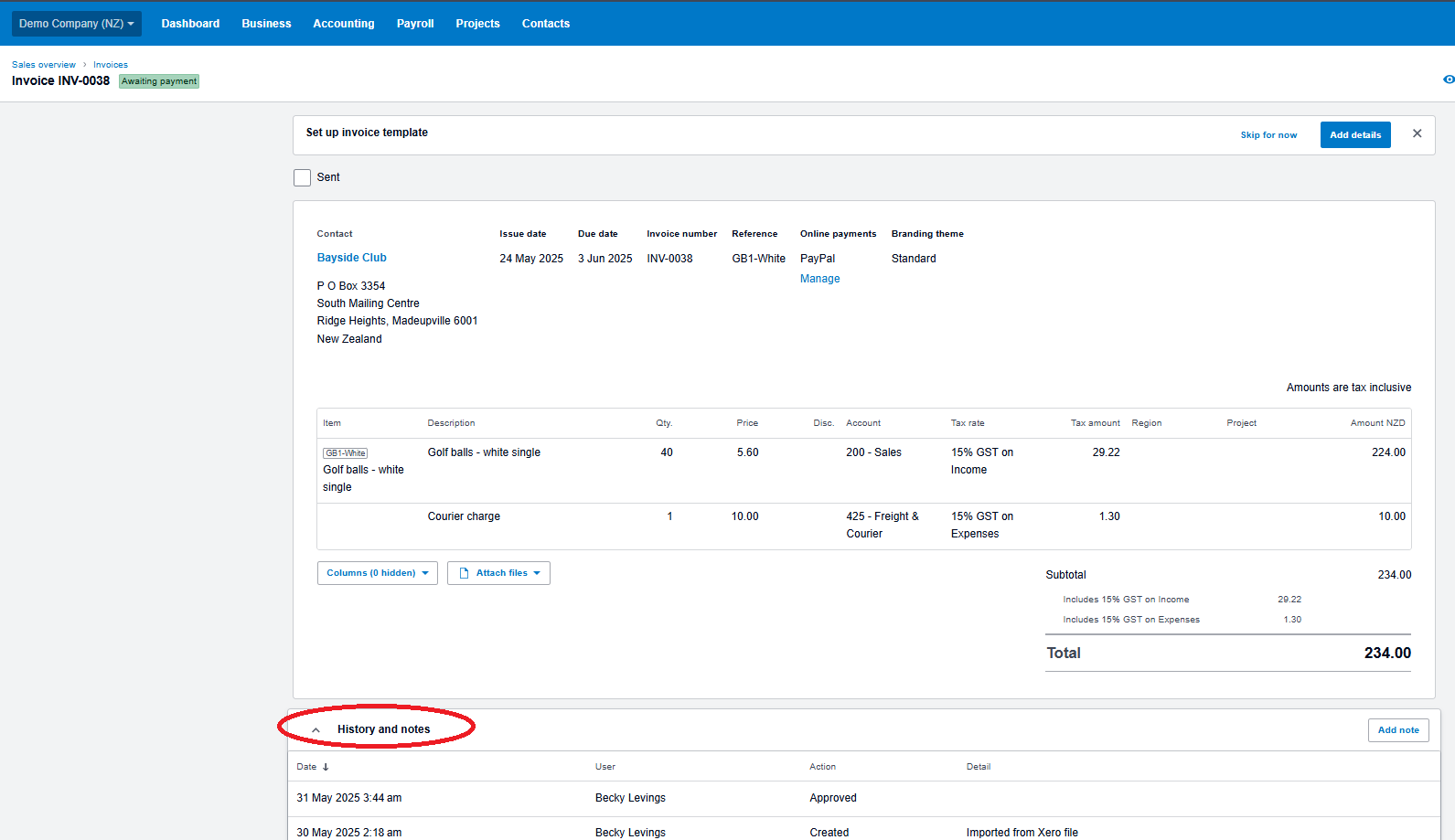
Did you know every invoice, bill, and transaction in Xero includes a built-in audit trail?
It's a feature some users might overlook, but the History & Notes feature lets you easily see who made changes, what was updated, and when - helping you and your finance team stay connected and organised.
To view the history for any transaction: - Open the transaction (invoice, bill, or payment) you want to check.
- Scroll down to the
History & Notes section at the bottom of the page.
- Click History & Notes to view a detailed timeline of changes.
This feature ensures everyone is on the same page and provides invaluable context for financial reviews – especially crucial during audits or when delegating tasks. |
|
|
TAX QUESTION OF THE MONTH: |
QUESTION:
A marketing consultant, Karen, recently started her own business from home. She wants to know how she can claim some of her household bills and car running costs as business expenses.
Key Details: - Home Office: She has a dedicated office space that takes up 10% of her home's total floor area (20m. out of 200m.
-
Household Bills: Her total annual home costs (rates, insurance, power, mortgage interest) are around $30,000.
-
Car Use: She uses the family car for work and personal trips. A logbook shows that 40% of her car travel is for business.
-
Car Costs: Her total annual car running costs (fuel, insurance, WOF, etc.) are about $8,000.
What can she claim, and what records does she need to keep? |
ANSWER:
When you use something for both business and private life, like a home or a car, you can claim the business portion of the costs as a tax deduction. Here’s a simple breakdown of how it works for Karen.
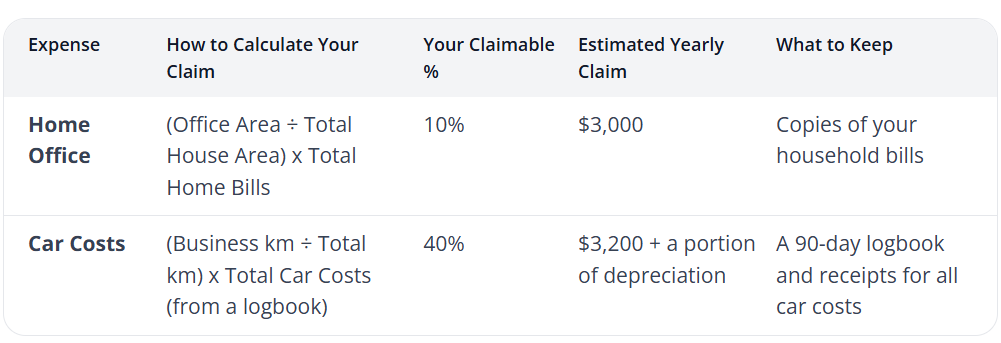
1. Claiming Your Home Office Costs How it Works: Think of your total household bills as a single pot of money. Because Karen's business uses 10% of the house's space, she can claim 10% of that pot as a business expense. The fact that the office is occasionally used for personal things is okay, as its main purpose is for business. How to Calculate the Claim 1. Find the business percentage: - Office Area ÷ Total House Area = 10%
2. Calculate the deductible amount: -
Total Annual Home Costs x 10% = Claimable Amount
- $30,000 x 10% = $3,000
Karen can claim $3,000 for her home office this year. What Records to Keep: Keep copies of the bills you are claiming a percentage of, such as rates notices, power bills, insurance invoices, and mortgage interest statements. 2. Claiming Your Car Costs
How it Works:
You need to figure out the split between business and private use of your car. The best way to do this is by keeping a logbook for 90 days. The business percentage you get from the logbook can then be used for up to three years.
How to Calculate the Claim: 1. Find the business percentage from the logbook: - Karen’s logbook shows her business use is 40%.
2. Apply this percentage to your car costs: - Total Annual Car Costs x 40% = Claimable Amount
- $8,000 x 40% = $3,200
Karen can claim $3,200 for her car's running costs. She can also claim 40% of the car's depreciation (the loss in value over the year), which provides an extra deduction.
What Records to Keep - A logbook for 90 days: For every business trip in that period, record the date, distance, and reason for the trip.
-
Receipts: Keep all receipts for your car costs, like fuel, insurance, and repairs.
Simple Summary |
For more detailed rules on business deductions, the official guidance is in Part D of the Income Tax Act 2007, but this summary covers the key steps you need to follow. |
|
|
|
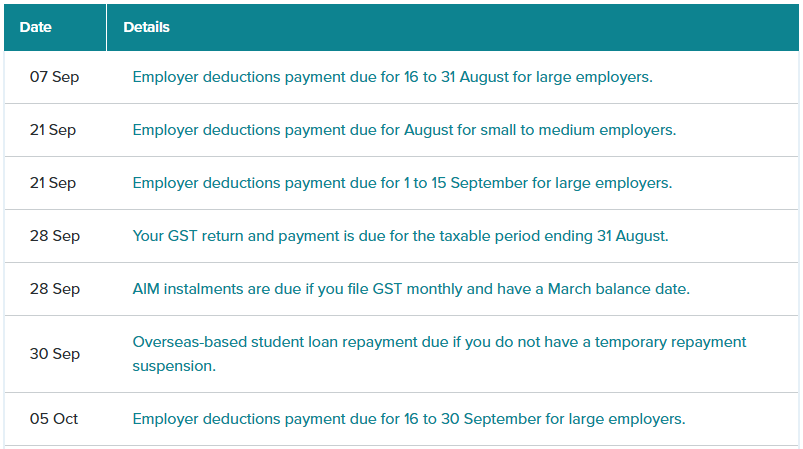
IRD UPCOMING TAX PAYMENT DATES |
|
|
|
|