Keep up-to-date with us and what's happening in the business world |
|
|
|
- Planning for Success in the New Financial Year - 2026 Annual Accounts Questionnaires - Making Every Litre Count: Practical Fuel-Saving Tips for Your Business
- Are You up to Speed With the Recent Changes to Fringe Benefit Tax (FBT)? - Xero Tip of the Month: Save Time With Xero’s Invoice Due Date Shortcuts
- Tax Question of the Month: Case Study - Simplifying Tax in the 2026/27 Financial Year - IRD Upcoming Tax Payment Dates |
|
|
|
The start of a new financial year is an important milestone for businesses and individuals alike. It marks the close of one chapter and the beginning of another - providing a fresh opportunity to refocus on your financial goals, strengthen your planning, and set the tone for the year ahead. While much of the attention around the financial year focuses on completing tax returns and finalising accounts, the beginning of a new financial year is equally important. It’s the ideal time to review your financial position and start the year with a clear strategy in place.
A Fresh Start for Your Finances
The new financial year offers a clean slate. It’s an opportunity to assess what worked well over the past year and consider where improvements can be made. Whether it’s refining your budgeting processes, improving cash flow management, or reviewing your business structure, small adjustments early in the year can have a significant impact over time.
Set the Direction for the Year Ahead
Starting the year with clear financial goals can help guide your decisions and keep your business moving in the right direction. This may involve planning for growth, managing costs more effectively, investing in new opportunities, or building stronger financial reserves. Taking the time to outline your priorities now can help ensure your financial decisions throughout the year align with your long-term objectives.
Stay Ahead of Changes Each financial year can bring updates to tax rules, reporting requirements, and employment obligations. Staying informed about these changes helps ensure you remain compliant and prepared. Our team closely monitors any developments that may affect you or your business and will continue to share relevant updates and guidance throughout the year.
Working Together in the 2026-2027 Financial Year Ahead
As your accountant, we’re here to support you throughout the financial year, not just at year-end. Regular communication and proactive planning can help ensure you stay on track, remain compliant, and make informed financial decisions as your business grows and evolves.
If there are any changes in your business, upcoming plans, or financial goals you would like to discuss, we encourage you to reach out to our team. The earlier we understand your plans, the better we can help you plan effectively and identify opportunities along the way. |
2026 ANNUAL ACCOUNTS QUESTIONNAIRES |
Your End of Financial Year (EOFY) Questionnaires will be arriving in your inbox shortly, in line with our April-May timeframe. To help ensure delivery, please make sure our email address is saved as a contact, as emails may otherwise be filtered into your spam or junk folder.
By now, you should have received our General Ledger Special, which provides detailed guidance on the EOFY questionnaire process and key actions required. To view this guide, simply click the button below.
For anyone who may have difficulty using the online system, the previous format is still available. Downloadable versions of the questionnaires can be accessed via our website under Services / 2026 Annual Accounts Questionnaires.
If you need any assistance or have questions about the process, please don't hesitate to call us at 04 970 1182. We are here to help! |
|
|
|
MAKING EVERY LITRE COUNT: PRACTICAL FUEL-SAVING TIPS FOR YOUR BUSINESS |
With ongoing fuel price pressures affecting many New Zealand businesses, managing vehicle-related costs is becoming an increasingly important part of protecting your bottom line.
Whether you operate a fleet or simply rely on day-to-day travel, small changes can make a meaningful difference over time, both in cost savings and overall efficiency. |
|
| |
|
Simple Ways to Reduce Fuel Costs -
Drive smoothly and consistently: Rapid acceleration and hard braking use more fuel than most people realise. A smoother driving style, including gentle acceleration, anticipating traffic, and maintaining steady speeds, can significantly improve efficiency.
-
Ease off the speed slightly: Higher speeds increase fuel consumption. Even a small reduction in speed on open roads can lead to noticeable savings over time.
-
Lighten the load: Carrying unnecessary weight or using roof racks when they’re not needed increases fuel use. Keeping vehicles as light and streamlined as possible helps improve efficiency.
-
Avoid unnecessary idling: Leaving vehicles running while stationary wastes fuel. Turning the engine off when parked or waiting (where safe to do so) can reduce unnecessary spend.
-
Check tyre pressure regularly: Under-inflated tyres create more resistance, meaning the engine has to work harder. Keeping tyres properly inflated is a simple way to improve fuel economy.
-
Stay on top of maintenance: Well-maintained vehicles run more efficiently. Regular servicing, oil changes, and wheel alignment can help reduce fuel consumption and prevent larger costs down the track.
-
Plan ahead where possible: Short trips and unplanned travel can use more fuel. Combining errands and planning routes can help reduce overall fuel usage.
While each of these changes may seem small on their own, applied consistently across a business they can add up to meaningful savings over the course of a year. A quick reminder
If fuel and travel costs are becoming a larger part of your expenses, it may be worth reviewing how these are tracked and managed. We can help you: - Identify trends in vehicle-related costs
- Review expense categories and claims
- Find opportunities to improve efficiency across your operations
If you’d like to talk through ways to better manage your business costs, feel free to get in touch with our team on 04 970 1182. |
ARE YOU UP TO SPEED WITH THE RECENT CHANGES TO FRINGE BENEFIT TAX (FBT)? |
|
|
There have been some recent changes to fringe benefit tax. But what exactly is fringe benefit tax (FBT) and how does this tax affect you as an employer?
What is fringe benefit tax? A fringe benefit is a non-cash benefit that you, or a third party, provide to one of your employees. This could include benefits like offering employees a car, health insurance, gym membership, gift cards and staff discounts, etc. In situations where you provide fringe benefits to your employees, you may need to pay fringe benefit tax (FBT) on these benefits.
|
| | |
|
How does FBT work?
As an employer, you’ll pay FBT on the cost of the benefit that you’re supplying to one of your employees. So, if you provide health insurance, for example, you’ll pay FBT based on the overall cost of providing this insurance to your team member. There are four main groups of taxable fringe benefits: - Motor vehicles available for personal use
- Free, subsidised or discounted goods and services
- Low-interest loans (other than those provided by life insurance companies)
- Employer contributions to sickness, accident or death benefit funds, specified insurance policies, and superannuation schemes not subject to employer superannuation contribution tax (ESCT).
You must register for FBT with the Inland Revenue as soon as you start providing the benefit (or benefits) to your employer. You can register online or by calling the Inland Revenue on 0800 377 772.
What are the recent changes to FBT?
From April 2026, changes to FBT have been introduced that may affect how employers, like yourself, treat certain benefits. In some cases, you now have more flexibility to choose whether to apply FBT or to treat a benefit as employment income with PAYE deducted.
It’s worth reviewing how you currently treat the affected employee benefits to make sure you’re complying with the new rules. Benefits where the rules have changed include: - Gift cards
- Equalisation of FBT and PAYE
-
Health and safety equipment
- Investment Boost and motor vehicles
Helping you comply with the FBT rules
If you’re unsure whether you have the right tax treatment for your employee benefits, come and talk to our team. We can review your current employee benefits and how they may be affected by the recent changes to FBT legislation and compliance. |
XERO TIP OF THE MONTH: SAVE TIME WITH XERO’S INVOICE DUE DATE SHORTCUTS |
Did you know you don’t have to manually calculate due dates for each invoice?
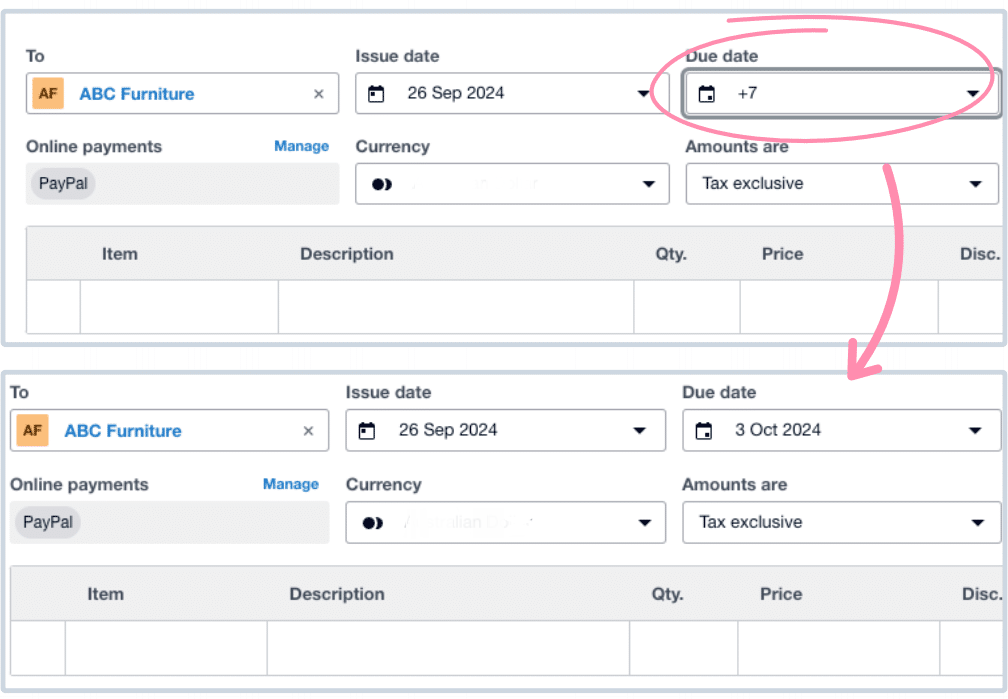
Here’s an easy Xero tip that many users overlook, but once you start using it, you’ll wonder how you ever lived without it. When you’re entering a due date on an invoice, you don’t need to stop and calculate the exact date based on your payment terms. Instead, Xero allows you to use quick shorthand to do the work for you.
Simply type shortcuts like “+7”, “+14”, or “+30” into the Due Date field, and Xero will automatically convert that into the correct calendar date. This is especially helpful if you work with different payment terms for different suppliers or if you’re batching a large number of invoices at once |
|
|
|
TAX QUESTION OF THE MONTH: |
QUESTION: Case Study: Simplifying Tax in the 2026/27 Financial Year
Meet Liam, the owner-operator of a small but busy building company. Liam is fantastic on the tools, but like many small business owners, he finds the paperwork and tax compliance a significant drain on his time and energy. His main frustrations revolve around record-keeping for expenses that have both business and private elements. The Challenge: The Burden of "Small" Details At his end-of-year meeting in early April 2026, Liam raised several key issues that were causing him stress: -
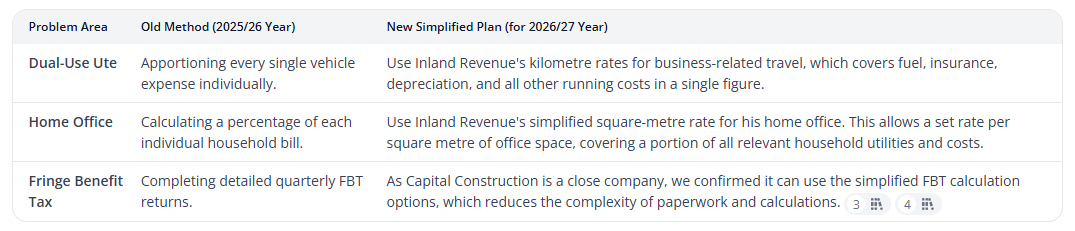
The Work Ute: Liam's ute is owned by the company but he also uses it for personal trips on the weekend. He was spending hours trying to meticulously split every fuel receipt, road user charge, and insurance invoice between business and private use.
-
The Home Office: He runs the administrative side of the business from a spare room at his home in Karori. Calculating the exact percentage of his mortgage interest, rates, power, and internet to claim as a business expense was complex and something he was never confident about.
-
Fringe Benefit Tax (FBT): The private use of the company ute is a fringe benefit, and Liam found the quarterly FBT returns confusing and time-consuming to prepare.
These compliance tasks were taking time away from quoting jobs and managing his team, directly impacting his business's growth. |
ANSWER:
The Solution: A Plan for a Simpler 2026/27
Recognising that these compliance costs were disproportionately high for the size of Liam's business, we mapped out a plan using several of Inland Revenue's simplification measures. The goal is to achieve a fair tax outcome at a lower compliance cost, freeing up Liam's time. |
The Outcome: More Time for Business By implementing this plan for the 2026/27 financial year, Liam now has a clear and straightforward process for managing his key expenses. - Time Saved: He anticipates saving several hours each month on bookkeeping, allowing him to focus on core business activities.
-
Reduced Stress: The uncertainty and hassle of complex calculations have been removed, giving him confidence that his records are correct and compliant.
- Improved Focus: Liam can now dedicate more energy to serving his clients and growing his business, rather than being bogged down by administration.
Liam's situation is a common one. Many of the tax system's simplification measures are designed specifically to reduce the compliance burden for small and medium-sized businesses, making it easier to manage tax affairs without significantly impacting the amount of revenue collected. |
References
Taxation (Annual Rates for 2018–19, Modernising Tax Administration, and Remedial Matters) Bill
RIS Pack - Taxation (Business Tax, Exchange of Information, and Remedial Matters) Bill RIS 4 (PDF 671 KB) Taxation (Annual Rates for 2018–19, Modernising Tax Administration, and Remedial Matters) Bill
Making tax simpler - Better business tax Summary of proposals (PDF 125 KB) RIS Pack - Taxation (Annual Rates, Employee Allowances, and Remedial Matters) Bill RIS 5 (PDF 589 KB)
RIS Pack - Taxation (Annual Rates, Employee Allowances, and Remedial Matters) Bill RIS 6 (PDF 652 KB) Income Tax Act 2007, s DA 1 |
|
|
IRD UPCOMING TAX PAYMENT DATES |
|
|
|
|